
📰BIDDEFORD | BUDGET | Seeds of Hope Executive Director Issues Public Statement
April 26, 2026, below is a statement from Vassie Fowler, Executive Director for Seeds of Hope Neighborhood Center, pertaining to recent public dialog regarding the center and 2027 city budget propsoal - please see below:
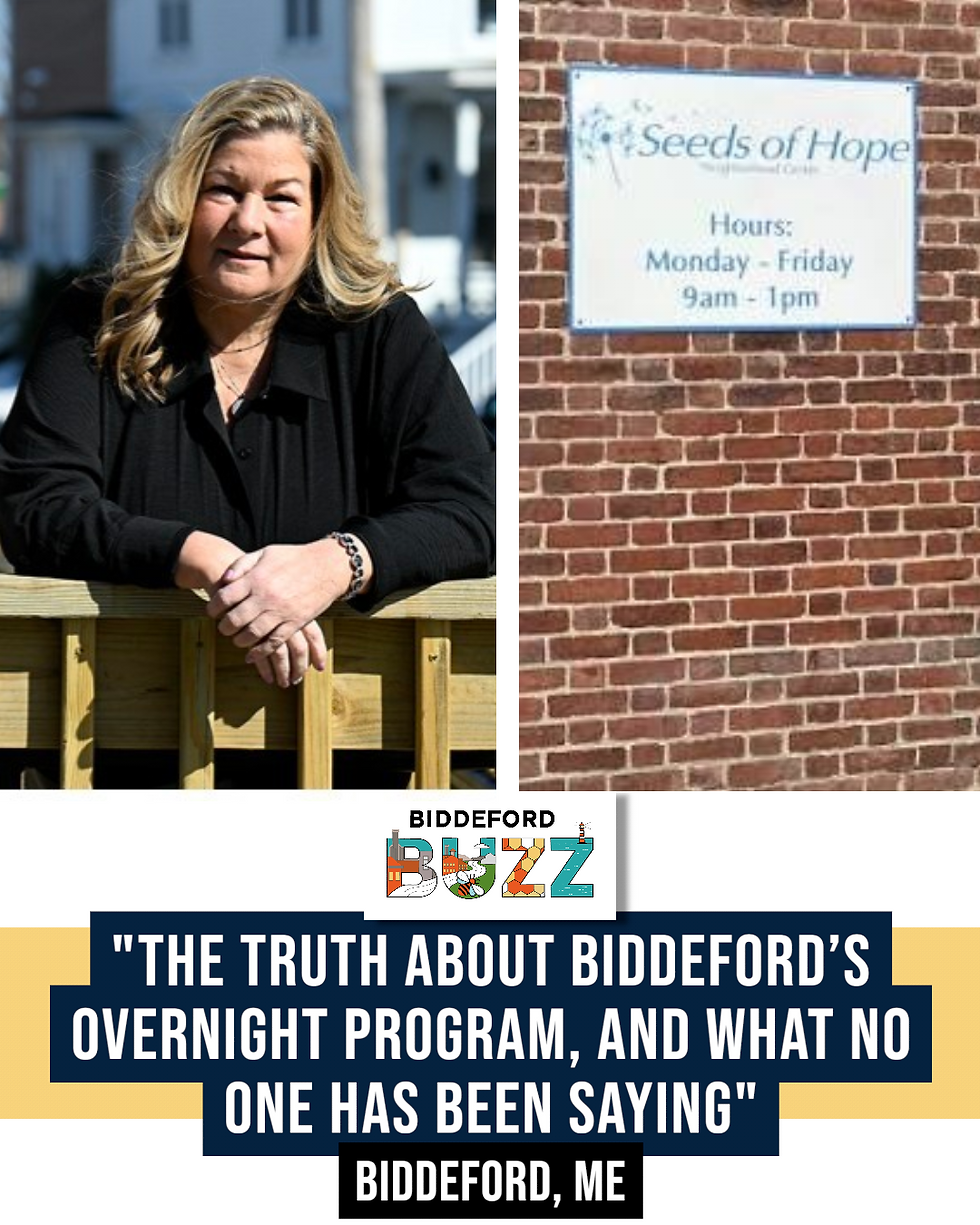
By Vassie Fowler, Executive Director, Seeds of Hope
THE TRUTH ABOUT BIDDEFORD’S OVERNIGHT PROGRAM, AND WHAT NO ONE HAS BEEN SAYING
For weeks, Seeds of Hope has remained quiet while misinformation, assumptions, and personal attacks have circulated online and in public spaces. That silence was intentional. Our energy belongs to the people we serve, not to feeding an online cycle of distortion.
But when misinformation begins shaping public understanding and influencing city decisions, silence is no longer responsible. Facts matter. The community deserves them. And we are done being quiet.
As Executive Director of Seeds of Hope, I want to provide clear, accurate information about our budget, our staffing, and the overnight program we operate on behalf of the City of Biddeford.
Biddeford Only Pays for Biddeford Residents, No One Else
This cannot be emphasized enough: Biddeford ONLY pays for Biddeford residents. Not another soul.
The city is charged $50 per person per night, and only for individuals who are verified Biddeford residents. If someone is not a Biddeford resident, the city does not pay for them. Period.
For those who qualify for General Assistance, the state reimburses 70% of the cost. For those who do not, the city pays the full amount, and again only for Biddeford residents. – and this is for the overnight program ONLY. The City of Biddeford does NOT contribute to the day program or the winter warming center program.
How We Verify Residency
There has been public speculation about how we determine who is a Biddeford resident. The answer is straightforward: We verify residency through multiple sources, and we have known many of these individuals for years.
Seeds of Hope’s staff and volunteers are long time members of this community. Many of the people we serve have been known to us for a decade or more. Generational poverty is real.
In addition:
Many individuals have state issued IDs listing a Biddeford address.
Others have residency confirmed through partnering agencies, including General Assistance, case managers, and healthcare providers.
For those without documentation, we rely on long standing relationships, community knowledge, and cross agency verification.
Do we serve people from other communities during the daytime? Yes, because we welcome everyone to Seeds of Hope. That is part of our mission.
But that does not translate to welcoming everyone into the overnight program. The overnight program is restricted to Biddeford residents only, and we follow that requirement strictly.
What the Overnight Program Actually Costs, And How the Math Works
There has been significant confusion about the cost of the overnight program and how it affects taxpayers. Here are the facts, in one clear explanation.
The total annual cost of the program is approximately $365,000+/-.
To fund that amount, the city must raise enough taxable value to generate $365,000 at the anticipated mil rate of 16.73 (reflecting the 12% anticipated increase from 14.94).
Here is how math works:
Convert the program cost into required taxable value
365,000/16.73×1000≈21,820,000
The city needs $21.8 million in taxable value to generate $365,000.
Distribute that taxable value across Biddeford’s 4,000 property tax paying households
21,820,000/4,000≈5,455
Each household is responsible for $5,455 in taxable value.
Convert that taxable value into actual tax dollars
(5,455/1000)×16.73≈91.3
And clearly, this is the average cost.
This results in a cost of $91 per household per year.
This is the full, transparent math behind the program, not speculation, not rumor, not political spin. Just the numbers.
For the price of a quarter a day, seniors, disabled adults, veterans, and medically fragile residents have a safe place to sleep instead of being pushed back into encampments, crisis, and preventable harm.
Seeds of Hope Has Not Asked the City for a Dime
Another critical truth:
Seeds of Hope has not asked the city for additional funding. Not one penny.
We have not increased our rate.
We have not shifted responsibility.
We have not expanded the program.
We are simply fulfilling the agreement the city asked us to take on.
The Overnight Program Is a City Initiative, Not Ours
The overnight program is not a Seeds of Hope initiative. It is a City of Biddeford initiative for Biddeford residents.
The city approached us because there was a clear need and no other agency was willing or able to take it on.
We did not request this program.
We did not design it.
We said yes because people’s lives were at stake.
It should also be noted, and this is a matter of public record, that the city asked Seeds of Hope to operate the overnight program so that the city could justify clearing encampments. The city signed an MOU with Seeds in 2024.
The city increased the workload and level of responsibility. Seeds is providing the most cost-efficient option available.
Why Our Budget Has Grown, And Why It Should Have
Some have questioned why Seeds of Hope’s budget increased from $140,000 in 2018 to $1.1 million today.
The answer is simple: The needs of this community have grown, and we have grown to meet them.
In 2018, Seeds of Hope was open 3–4 days a week, offering fellowship and basic food support — often peanut butter sandwiches.
There were:
No showers
No warming center
No overnight program
No housing navigation
No crisis intervention
No treatment referrals
No case management connections
Today, we serve nearly four times as many people and operate 24/7 for six months of the year.
More than 100 individuals moved into permanent housing in the past year alone. Dozens more entered treatment or recovery.
This is what effective, responsive community work looks like.
It is also important to note that the cost of living has increased by more than 31% since 2018, affecting every aspect of our budget, staffing, utilities, food, supplies, insurance, and basic operations.
Addressing the “There’s Money in Homelessness” Narrative
Another false narrative circulating publicly is the claim that “there’s money in homelessness” or that Seeds of Hope staff are somehow benefiting financially from this work.
This is simply untrue.
Our staff work long hours, often 10–12 hour shifts, holidays, snowstorms, Fridays, weekends, and sometimes six or seven days a week, because the people we serve do not stop needing support when the weather is bad or when the calendar says it’s a holiday.
Staff receive no benefits:
No health insurance
No retirement plan
No short or long term disability
No paid family leave
Compensation reflects the intensity, risk, and responsibility of the work, and the need to retain qualified, committed professionals in a field with extremely high burnout.
The idea that anyone is “getting rich” doing this work is not only false, but also deeply disrespectful to the people who show up every day to keep vulnerable residents alive.
Warming Center Funds Cannot Replace City Funding
MaineHousing’s warming center funds are restricted. They can only be used to expand hours during dangerous winter weather. They cannot legally replace municipal funding for a year-round city program.
“Ineffective”? The Data Says Otherwise
A small number of individuals in our community face such severe barriers, mental health conditions, disabilities, trauma histories, criminal records, or the absence of any viable housing options, that they may remain unhoused under the current system.
That is not a Seeds of Hope failure.
It is a system failure.
Our role is to keep these individuals alive, connected, and supported until the system provides appropriate housing. And we do that every single day.
What Happens If the City Eliminates the Budget Line?
If the city removes the GA budget line that funds the overnight program, the program ends.
But the need does not.
More than 30 Biddeford residents, many seniors, disabled individuals, and medically vulnerable adults will be forced back outside immediately.
There is:
No alternative shelter
No overflow plan
No other agency prepared to take this on
Ending the program does not save money. It simply shifts the cost to:
Emergency services
Public works
Police
County jail
Hospitals
Or we can let people live on the streets.
Those are the actual choices.
A Call for Facts, Not Fear
Seeds of Hope has always been available to answer questions, provide data, and discuss concerns.
Before decisions are made that will put vulnerable residents back on the street, I urge our community and our city leaders to seek accurate information.
The overnight program is not just a budget line.
It is a lifeline.
And it costs taxpayers less than a cup of coffee each week.
Seeds of Hope will continue to serve this community with transparency, compassion, and commitment. We ask the city to continue its commitment as well.
Respectfully,
Vassie Fowler
Executive Director, Seeds of Hope Neighborhood Center


Comments