
📰BIDDEFORD | OPINION: When a Development Moratorium Makes Sense
By Loren McCready, Biddeford Resident
January 21, 2026, Last night, Biddeford’s City Council passed a development moratorium affecting the Institutional Zone, making this a moment worth paying attention to. Moratoria are not everyday planning tools. They are typically used when growth is moving faster than infrastructure, land-use regulations, or long-term planning can keep up.
State law sets clear limits on when a moratorium may be used. Under Maine statute, a municipality must show that development would likely overburden public facilities, or that existing comprehensive plans and ordinances are insufficient to “prevent serious public harm” within a defined area. (30-A M.R.S. § 4356)
Those standards matter now because Biddeford is experiencing significant growth pressure in multiple parts of the city.
What Council Has Been Reviewing
At last week’s City Council meeting, members reviewed development activity across Biddeford. Some projects are complete, others are underway, and more are expected this spring. Throughout those discussions, several key issues surfaced repeatedly, including sewer capacity and whether current development aligns with the City’s broader housing affordability goals.
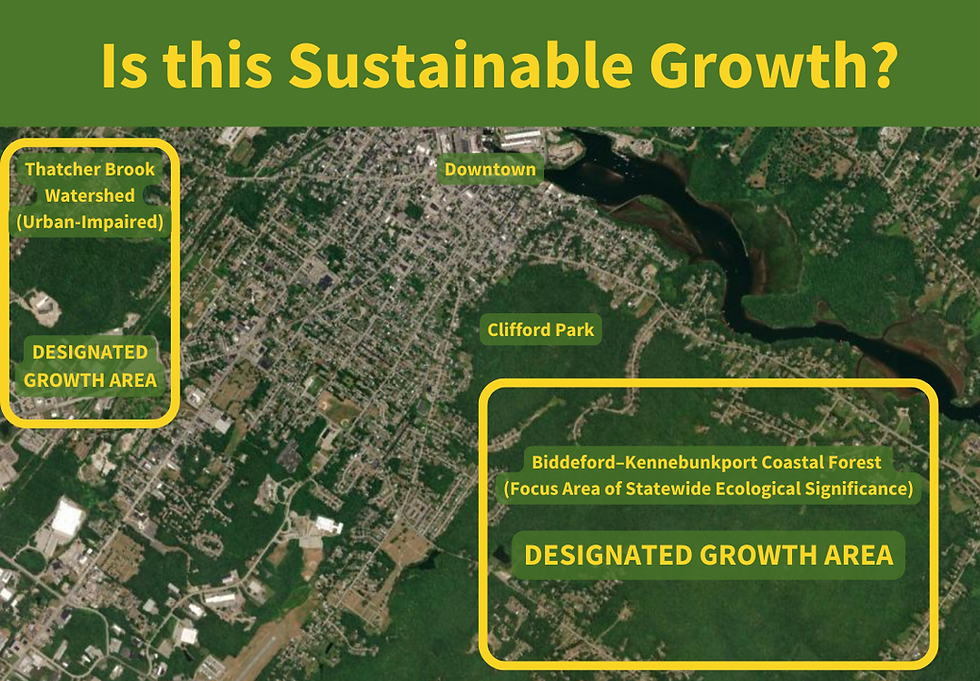
In discussions regarding many of these projects, large-scale development has often been framed as a way to expand housing supply and relieve costs more broadly; however, when such projects are not aligned with smart growth principles or local affordability, that framing can overlook whether high-cost, investor-driven development meaningfully reduces local housing costs or instead contributes to higher land values, rising assessments, and long-term tax pressure that can push out existing residents.
In several areas, these concerns are no longer abstract.
Western Biddeford and the Thatcher Brook Watershed
In western Biddeford, development continues to intensify within the Thatcher Brook watershed, particularly near the end of Barra Road. The watershed has been classified as urban-impaired for over a decade, yet it remains a primary focus for new growth.

The City has acknowledged severe sewer capacity limitations and the need for approximately $1 million in public investment to support additional development, an expenditure the City Council recently approved unanimously. A 250-unit apartment complex opened a year ago with one-bedroom rents starting at $2,250 per month. That pricing does not align with how the project was described in its 2021 Credit Enhancement Agreement, which identified the development as “workforce housing,” defined locally as affordable to households earning up to 80 percent of area median income—corresponding in Biddeford to rents of approximately $1,400 per month.
Under the same agreement, the City committed to returning 30 percent of future tax revenue to developer Mike Eon and associated entities for a period of 15 years. In addition, most of the affordable housing proposed under that agreement has not secured state funding, and state agencies have raised objections to designating the area for growth due to environmental strain, introducing uncertainty about the project’s long-term viability. Taken together, these factors raise questions about whether the project is meeting the City’s housing goals or land-use expectations in the Comprehensive Plan.
With additional construction planned this spring, the combination of documented infrastructure strain, ongoing environmental remediation, and “workforce housing” prices beyond the reach of many local residents raises serious questions about how growth in this area is being managed.
Eastern Biddeford and the Coastal Forest
In eastern Biddeford, subdivision development continues within the Biddeford–Kennebunkport Coastal Forest, formerly known as the Vernal Pool Complex. In a presentation to the Biddeford Conservation Commission last August, the Maine Department of Inland Fisheries and Wildlife described the area as among the most ecologically significant in Maine, a point echoed by the City’s planner at last week’s Council meeting.

Despite the ecological value of the region being well documented and raised repeatedly during development reviews, multiple subdivisions have been approved or are advancing.
Environmental standards have been applied unevenly in this area for years, and that pattern continues. Mike Eon’s West Brook Subdivision, located adjacent to Clifford Park, has a documented history of environmental compliance issues, including departures from applicable standards identified during review and permitting. The project is expected to produce homes priced at $600,000 or more and allows construction on flood-prone wetland soils in a location that interrupts a key wildlife corridor between Clifford Park and the Coastal Forest. A separate subdivision proposal from Bedard Homes on nearby land is expected to result in homes priced closer to $800,000 or more.
Both projects have advanced despite the City lacking a state-approved Comprehensive Plan for many years—its most recent plan dates to 1999—and despite state agency findings that development in this area conflicts with Growth Management Act standards.
The public record for the Bedard project also includes statements from the Public Works Director noting existing sewer capacity strain, with additional development—including West Brook and the planned extension of Parkside Drive—expected to place further pressure on the system.
What the State Has Raised
These same areas are central to the State’s repeated rejection of Biddeford’s Comprehensive Plan, which has now been returned five times since City Council adopted it in 2023. The Maine Department of Environmental Protection and the Maine Department of Inland Fisheries and Wildlife, working in coordination with the Maine Department of Agriculture, Conservation, and Forestry, have raised clear concerns regarding growth area designation, water resources, and habitat impacts in both the Thatcher Brook watershed and the Biddeford–Kennebunkport Coastal Forest.
Why This Matters Now
A development moratorium can be an effective planning tool when it is grounded in clearly documented conditions on the ground. That requires identifying specific constraints—such as infrastructure limitations, elevated environmental risk, or land-use regulations that have not kept pace with recent development. The Town of Brunswick recently adopted a development moratorium that provides a strong example of this approach, with clearly articulated findings and a rationale that aligns with state law.
Biddeford already has much of this information. Council has reviewed development maps. Infrastructure limits have been discussed in public meetings. State agencies have identified where current growth patterns conflict with environmental and planning standards.
If the City chooses to use a moratorium, it should be grounded in those realities and applied consistently. Biddeford needs additional housing, but it also requires functioning infrastructure, protected natural resources, and planning decisions applied evenly across the city.
Moratoria work best when they are used carefully, transparently, and where the public record clearly supports their use.


Nothing about LOW INCOME housing for the elderly and poor. $2500 a month is NOT affordable for us. Biddeford just wants to get rid of us